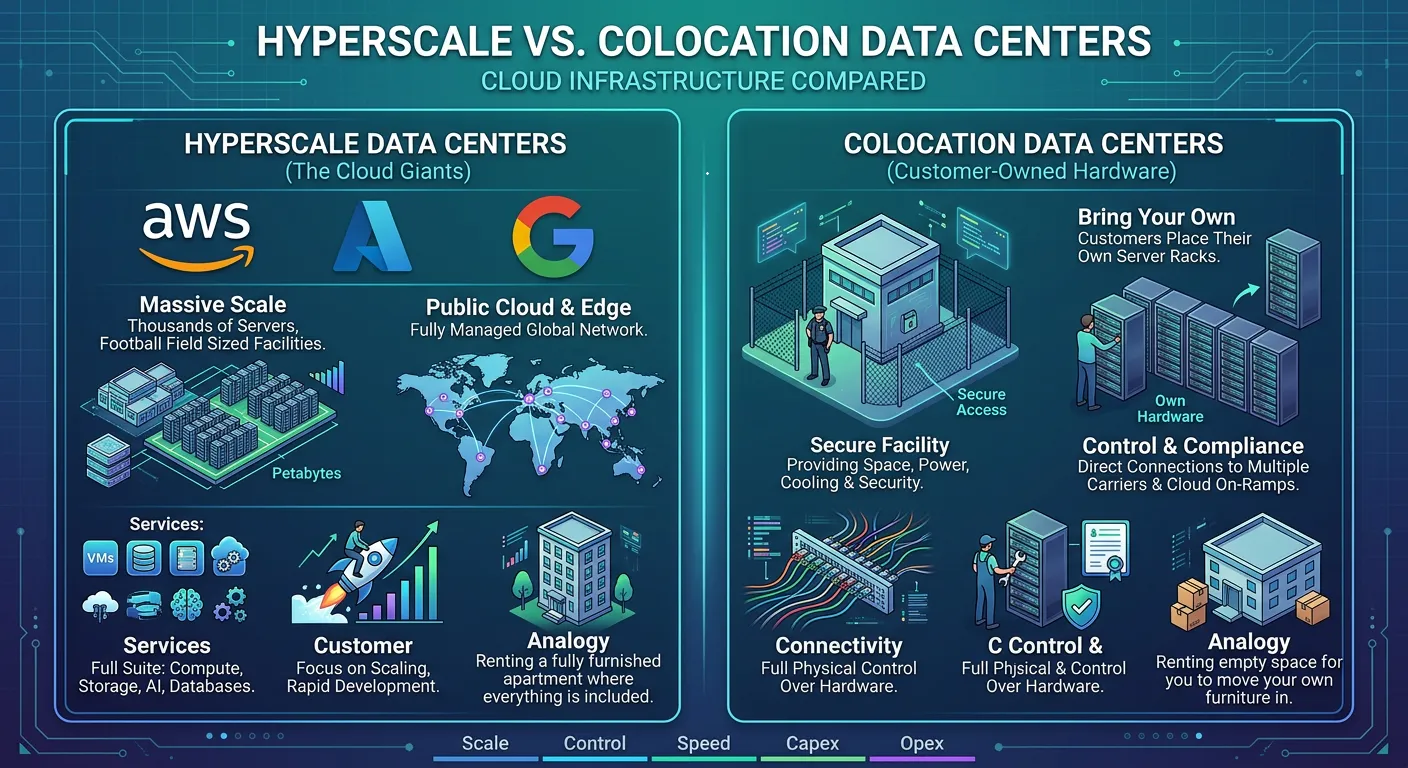
Public Cloud transformed how organisations approach digital transformation. Instant provisioning, global scale, and negligible upfront commitment made possible by hyperscale operators AWS, Azure, and GCP triggered adoption of vendor driven cloud first and cloud only strategies. But as cost overruns, security and control questions (for example, data sovereignty) come under scrutiny, many enterprises are asking themselves the hard question: is an all-in public cloud strategy the right answer for everything?
The answer is generally no - and while reversals are a hard pill to swallow, increasingly, the smarter answer is a hybrid one.
The case for public cloud
Public cloud does certain things exceptionally well. For variable or unpredictable workloads, it offers genuine elasticity - spin up capacity in minutes, release it when you're done. Development and test environments, use of PaaS applications, and burst compute are natural fits.
The managed services layer is also compelling. Databases, AI/ML tooling, monitoring, and security services are available on demand, reducing some burden on internal teams. For startups and scale-ups without dedicated infrastructure staff, this can be transformative.
Where public cloud falls short
For predictable, steady-state workloads, cloud economics can be brutal. Running core enterprise applications such as ERP and other database driven applications, file services etc., on public cloud tends to generate bills that can dwarf equivalent on-premises or colocation costs. Add to this egress charges, licensing uplifts, and the complexity of reserved instance management, and a cloud only approach can start to look far less attractive.
Data sovereignty is another growing concern. With GDPR, Schrems II ruling and DORA all tightening requirements around where data resides and who can access it, the jurisdictional exposure of hyperscale infrastructure - much of it potentially subject to US law under the CLOUD Act - is a material compliance risk for Irish and EU-regulated businesses.
Latency, too, remains a limiting factor. Mission-critical applications that require consistent, low-latency connectivity to on-premises systems often struggle in a purely public cloud model.
The colocation advantage
Colocation in a professionally managed, carrier-neutral data centre delivers more physical security, power resilience, and connectivity than an enterprise facility, without the capital cost of building your own.
For many workloads, particularly those that are compute-intensive, data-heavy, or latency-sensitive, the economics are compelling: predictable monthly costs, no egress fees, and direct access to a rich ecosystem of network providers and cloud on-ramps.
Colocation also gives you control. Your infrastructure, your configuration, your security posture - without being locked into a single vendor's pricing model or service roadmap.
The case for hybrid
The most resilient enterprises aren't choosing between cloud and colocation - they're using both deliberately, and many that previously pursued a cloud-only strategy are now either repatriating workloads to private infrastructure or actively planning to do so.
Core and sensitive workloads run on dedicated colocated infrastructure. Cloud-native and burst workloads run on hyperscale services, connected via private interconnects that keep traffic off the public internet.
This hybrid model delivers the flexibility of cloud where it makes sense, the cost efficiency and control of colocation where it matters most, and the data sovereignty that Irish regulations increasingly demand.
The question isn't cloud versus colo. It's knowing which workloads belong where - and having the right infrastructure partner to support both.